

“Nothing is happening, but my mind is still running.”
If that feels familiar, you are not failing at rest. You may be carrying a mix of unfinished tasks, future worries, old conversations, ideas, and questions with nowhere to land. At night or in a quiet moment, there is less competing for your attention, so that mental backlog can become much easier to notice.
A racing mind can also be part of anxiety, ADHD, insomnia, depression, trauma, or other experiences. This article cannot tell you which applies to you. It offers a small, practical way to reduce the burden of remembering everything, not a diagnosis or treatment.
If your mind never stops thinking, it may be cycling through unfinished tasks, worry, rumination, ideas, or emotional material. The symptom is real, but it is not specific enough to diagnose its cause. A practical first step is to capture anything actionable, name what cannot be solved now, and seek support if the pattern is persistent or distressing.
Is it normal for your thoughts to never stop?
A busy stream of thoughts can happen during stress, excitement, major life changes, or quiet moments. It becomes more important to address when it regularly disrupts sleep, concentration, mood, relationships, or daily functioning.
One study comparing people with insomnia, people with bipolar disorder, and healthy controls found that racing thoughts were elevated in both clinical groups. The authors described racing thoughts as a transdiagnostic symptom, which means the experience can appear across different conditions and does not identify one diagnosis.[5]
Your mind is not supposed to be a perfect storage device
There is a useful difference between having a lot on your mind and having a problem you should simply “think harder” about.
Psychologists use terms such as worry for repeated future-focused thinking and rumination for repeated dwelling on problems or past events. In real life, they often blur together: tomorrow’s deadline turns into a replay of today’s mistake, then into a vague fear that you have forgotten something important.
These loops are not trivial. A systematic review and meta-analysis of 55 studies in non-clinical populations found that more worry and rumination were consistently associated with poorer sleep, including lower sleep quality and longer time to fall asleep.[1] That is an association, not proof that one thought causes one bad night. But it helps explain why “my brain will not switch off” can feel so exhausting.
Trying to force thoughts away can make them feel louder
“Stop thinking about it” is understandable advice. It is also hard to do on command.
Research on thought suppression has found that deliberately trying not to think about something can sometimes make that thought return more often. The evidence is nuanced, and it does not mean every unwanted thought needs attention. It does mean that fighting your mind all night is not the only option.[2]00019-7)
A gentler move is to separate two questions:
- Is there anything here I need to remember or do?
- Is this something I can solve right now?
If the answer to the second question is no, you do not have to finish solving it before you sleep. You can give it a place to wait.
What is usually running in a mind that never stops
Racing thoughts rarely arrive as one clear problem. When people describe them, the same four patterns tend to show up. They are not diagnoses. They are simply useful to name, because each one responds to a slightly different move.
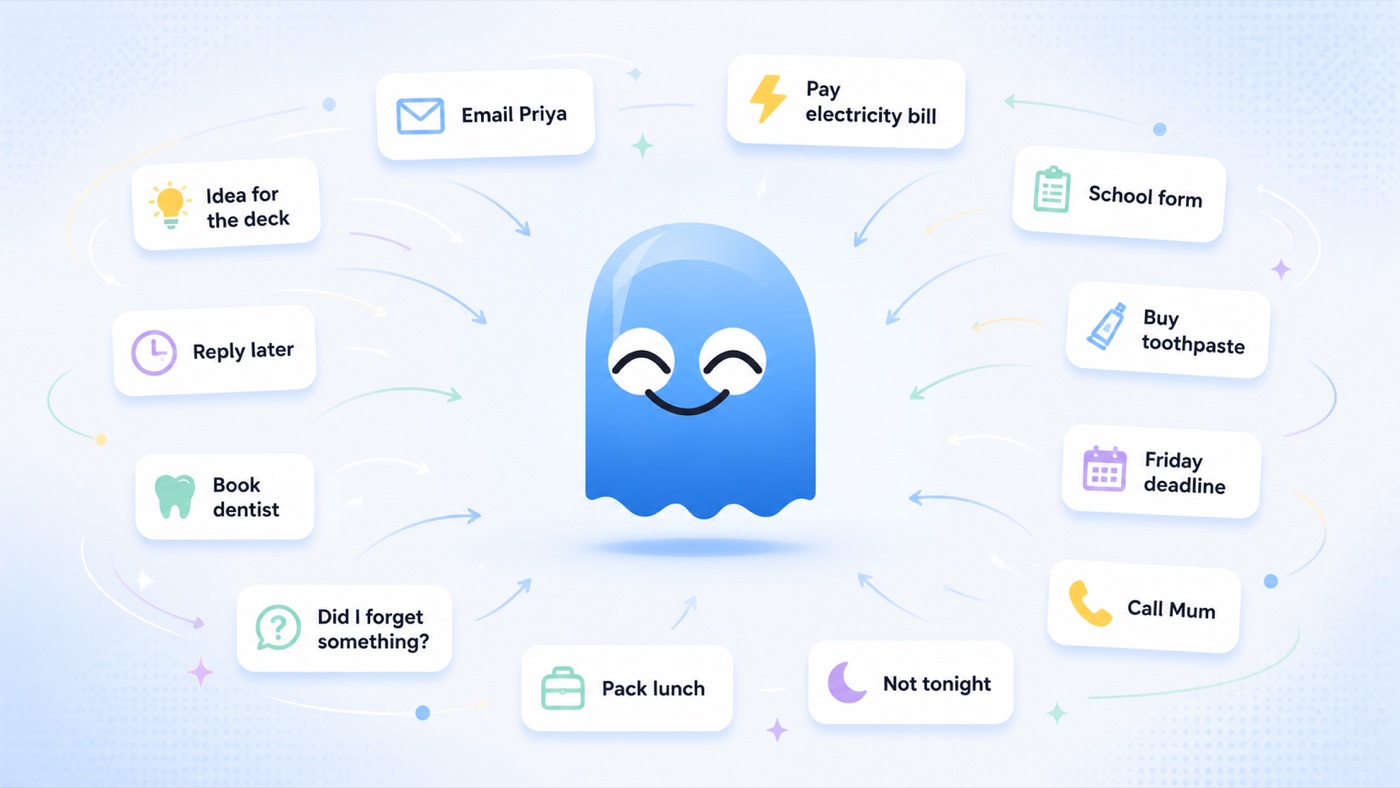
- Open loops: tasks you started, promised, or noticed and never closed. “Reply to the school email.” “Book the car service.” “Send the file to Priya.” These want a next step and a place to live.
- Future worry: questions you cannot answer yet. “What if the visa is late?” “What if the presentation goes badly?” These want a limit, not a solution at midnight.
- Replaying the past: the conversation you wish had gone differently, the mistake you keep re-examining. This is closer to rumination and often responds better to a kind boundary (“not tonight”) than to more analysis.
- Overstimulation: a day with too much input, too many screens, or too little quiet. The mind is not carrying a problem. It is still spinning from the day.
Open loops are the pattern you can do the most about, and there is some evidence for why. In a series of experiments, people who wrote a specific plan for an unfinished goal showed fewer intrusive thoughts about that goal during a later task than people who only thought about the goal. The plan did not have to be carried out. It only had to exist.[6] That is one reason “I will email Priya at 9” tends to sit more quietly in your head than “I need to deal with the Priya thing.”
A sixty-second script for when it starts at 2 a.m.
Waking up with a busy mind is different from a noisy evening. You are tired, the light is off, and the temptation is to either plan everything or fight every thought.
Try a shorter move:
- Keep the light low. You do not need to sit up.
- Say or write one sentence per loop. “Tomorrow: call the dentist. Not tonight: the money worry.”
- Say the closing sentence: “It is captured. I can return to it tomorrow.”
- Stop. Do not open the calendar. Do not reorder the list.
If you use MyOffload for this, one short voice note is enough. It keeps the messy sentence, creates the task and any reminder you asked for, and the rest waits as a note until morning.
If you are still wide awake after what feels like a long time, general sleep guidance often suggests getting up briefly and doing something quiet in dim light, then returning to bed when you feel sleepy, rather than lying there arguing with your thoughts. If night waking with racing thoughts is happening most nights, that pattern is worth raising with a clinician.
The next morning: close what you opened
A night capture only works if the morning honours it. Otherwise your mind learns that the holding place is not trustworthy, and it goes back to rehearsing.
Keep the morning review small:
- Read what you captured. Delete anything that no longer matters in daylight.
- For each real task, decide the next visible step. If a task is big or vague, Break Down in MyOffload can split it into smaller steps you can actually start.
- If several tasks belong to today, tap Plan My Day so the app orders them and you start from the top instead of scanning.
- Leave the worries and questions as notes. You can revisit them when you have the information you were missing.
This takes a few minutes. The payoff is that your mind starts to believe that captured really means handled.
If you have ADHD
Many people with ADHD describe a mind that jumps between thoughts, ideas, and half-finished tasks, especially when the day quiets down. The same offloading approach applies, with two adjustments. First, capture immediately, because the thought may not come back if you wait for a tidier moment. Second, keep the review predictable, because a system you only check when you remember to will not feel safe enough to let go of the rehearsing.
None of this is ADHD treatment. It is a way to reduce how much your working memory has to carry while you and your clinician handle the rest.
Try a three-minute offload, not a perfect plan
Open MyOffload and capture what is circling without editing it. Each offload gives you up to three minutes to say the messy version out loud.
MyOffload keeps the full thought, turns actionable parts into tasks, and creates reminders when you ask for them, so you are not left sorting everything by hand.
Use three simple labels when they help:
- Do: things that need an action
- Remember: details, ideas, or reminders you do not want to lose
- Not tonight: worries or questions you cannot resolve right now
For each Do item, add only the next visible step. Not “sort out finances.” Try “open the bank app tomorrow at 10.” In MyOffload, you can say that naturally and review the task and reminder it creates.
Then stop.
The point is not to build a beautiful system at bedtime. The point is to make a trustworthy holding place, so your brain is no longer the only place responsible for remembering. MyOffload is built to be that holding place when your thoughts arrive as a tangled mix, not a neat checklist.
A helpful closing sentence is: “It is captured. I can return to it tomorrow.”
If you want the complete process and evidence, read What Is a Mental Offload?
Why does my mind never shut up at night?
Quiet removes many of the distractions that carried your attention during the day. That can make unfinished tasks, worry, and rumination easier to notice. Research links worry and rumination with poorer sleep, but it does not prove that one thought causes one bad night.
The goal is not to force your mind blank. Capture what needs action, give tomorrow's tasks a cue, and name what cannot be solved tonight.
What research can, and cannot, say about writing it down
There is promising evidence for this kind of externalization, often called cognitive offloading: using something outside your head, such as a note or reminder, to reduce a task’s internal memory demands. A recent meta-analysis found that offloading can improve performance on memory-based tasks and reduce differences in performance between people.[3]
There is also one often-cited laboratory study in which 57 healthy young adults spent five minutes writing either a future to-do list or a list of completed activities. The to-do-list group fell asleep faster that night.[4]
That result is interesting, not magic. It was a small, single-night study in a specific group of people. It does not show that list-writing treats insomnia, anxiety, or ADHD. It does suggest a reasonable experiment: when unfinished tasks are keeping you mentally on call, putting them somewhere reliable may make it easier to stop rehearsing them.
Where MyOffload fits
MyOffload is for the moment before an idea becomes a polished task.
Open it and say the messy version:
“Tomorrow I need to email Priya, I should pay the bill, I keep worrying I am forgetting something for school, and I had an idea about the presentation.”
You do not need to sort, prioritize, or make a neat list while the thought is still moving. MyOffload is designed to save the thought, keep the context, and pull out genuine tasks when there are any. The rest can remain a note instead of becoming another urgent item on a productivity list.
You do not need to plan the whole day at night. Tomorrow, use Break Down if a task is too large and tap Plan My Day if you want MyOffload to prioritize and order the day for you.
If evenings are especially noisy, an optional daily offload reminder can create a small “closing shift” before bed. Keep it deliberately light: one minute is enough. Missing a day does not mean you failed at the habit.
MyOffload is not a replacement for mental-health care or sleep treatment. It is a place to put thoughts down when carrying them alone is adding to the noise.
When an offload is not enough
Consider talking with a qualified clinician if racing thoughts are persistent, cause substantial distress, regularly disrupt sleep or daily life, come with major changes in mood or behavior, or feel frightening or unsafe. If you might harm yourself or someone else, seek immediate local emergency or crisis support.
Questions about a mind that never stops
Is it normal for thoughts to keep running?
It can happen during stress or quiet moments. Persistent, distressing, or sleep-disrupting racing thoughts deserve attention because several mental-health and sleep conditions can include them.
What can I do when I cannot stop thinking?
Capture actionable thoughts, give future tasks a cue, name what cannot be solved tonight, and stop trying to force every thought away.
Does a racing mind mean I have ADHD or anxiety?
No. Racing thoughts can occur in several conditions and in people without a diagnosis. Only a qualified professional can evaluate your symptoms in context.
Why is my mind racing at 2 a.m.?
Waking in the night removes the distractions that carried your attention during the day, so unfinished tasks and worries are easier to notice. Capture anything actionable in one sentence, name what cannot be solved tonight, and avoid turning the moment into a planning session.
Can writing things down help me sleep?
One small laboratory study found that people who spent five minutes writing tomorrow's to-do list fell asleep faster that night than people who wrote about completed tasks. It was a single-night study in healthy young adults, so it does not show that list-writing treats insomnia. It does suggest that putting unfinished tasks somewhere reliable is a reasonable experiment.
The bottom line
You do not need to win an argument with every thought in your head.
Try giving the actionable parts a home, naming what can wait, and returning to the rest tomorrow. A quieter mind may not come from thinking less. Sometimes it starts with asking your mind to remember less.
Research behind this article
- Burnett, L. K., & Richmond, L. L. (2026). Meta-analytic investigations of the effect of cognitive offloading on memory-based task performance and interindividual variability. Memory & Cognition.[3]
- Clancy, F., Prestwich, A., Caperon, L., Tsipa, A., & O’Connor, D. B. (2020). The association between worry and rumination with sleep in non-clinical populations: a systematic review and meta-analysis. Health Psychology Review.[1]
- Scullin, M. K., Krueger, M. L., Ballard, H., Pruett, N., & Bliwise, D. L. (2018). The effects of bedtime writing on difficulty falling asleep: A polysomnographic study comparing to-do lists and completed activity lists. Journal of Experimental Psychology: General.[4]
- Rassin, E., Merckelbach, H., & Muris, P. (2000). Paradoxical and less paradoxical effects of thought suppression: a critical review. Clinical Psychology Review.[2]00019-7)
- Weiner, L., et al. (2021). Racing thoughts in patients with insomnia disorder, ADHD, and healthy controls. Comprehensive Psychiatry.
- Masicampo, E. J., & Baumeister, R. F. (2011). Consider it done! Plan making can eliminate the cognitive effects of unfulfilled goals. Journal of Personality and Social Psychology.[6]
Try MyOffload
Give the thought somewhere useful to go
Say the messy version. MyOffload keeps the context and turns the actionable parts into tasks, notes, and requested reminders for you to review.
Download MyOffload for iPhone